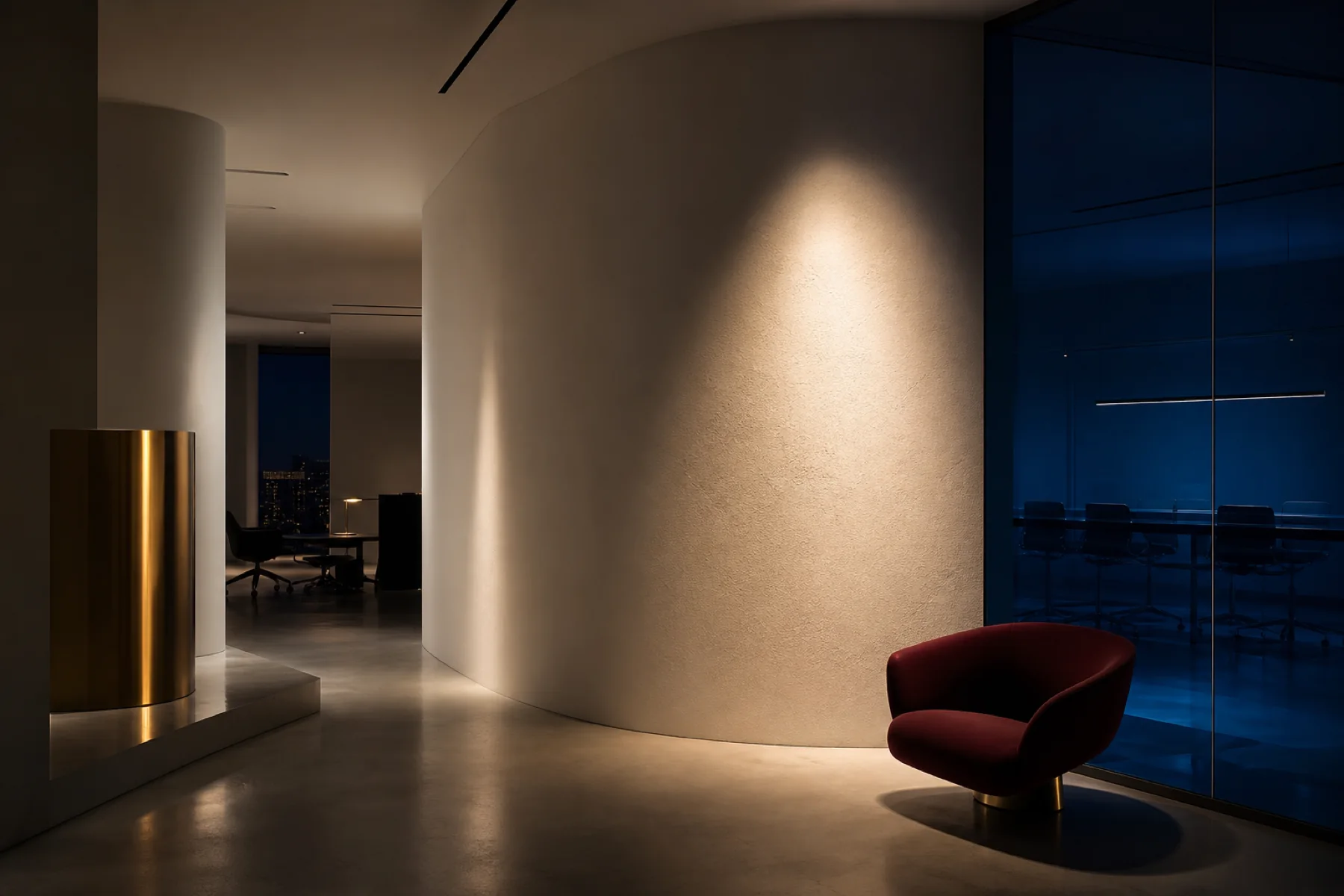
Choosing art for an office means balancing encounter and endurance. The work may be seen by employees every day, noticed by a client for one minute or glimpsed from the far end of a corridor. It must belong to the architecture, withstand the conditions and feel considered without turning the workplace into a showroom.
Begin with how the office is used, not with a search for something that matches the brand colours. A useful art plan identifies the people, distances and rhythms of each zone before selecting a particular image.
Map the office by experience
Walk through the space in the order a visitor and an employee would experience it. Photograph each candidate wall straight on and from the normal approach. Record wall dimensions, furniture, doors, screens, switches, vents, sprinklers, direct sun and the distance available for viewing.
Then give each location a role. The reception wall may need one legible focal work. A corridor can support a sequence discovered in motion. A conference room may benefit from an image with depth that rewards repeated looking. A private office can hold something more intimate, while a shared workspace usually needs enough visual clarity to avoid becoming constant noise.
Do not try to give every wall equal importance. A collection becomes calmer when it has pauses.
Choose a feeling before a palette
Ask what the space should communicate: curiosity, precision, warmth, resilience, openness or productive tension. These are more useful selection words than “blue” or “neutral.” Brand colours can create continuity, but exact matching often makes art feel like an extension of signage.
Look for a relationship rather than a replica. A painting may echo the geometry of the architecture, bring organic movement into a rigid room or introduce a controlled contrast to the existing palette. If the office is temporary or likely to be redesigned, choose work with an identity strong enough to survive a different wall.
Office art should not disappear into the interior. It should change the quality of attention without demanding it every second.
Consider subject and audience carefully
A workplace includes people with different histories, cultures and degrees of choice about what they see each day. Review figurative, political, religious, violent, sexual or otherwise intense imagery with that audience in mind. Complexity is not a flaw; surprise can make a collection memorable. But a shared environment requires intentional placement and enough context for a difficult work to be understood rather than imposed.
Invite input without asking a committee to design by compromise. A small selection team can define the brief, gather reactions from people who use the space and preserve a coherent point of view. Record why each work belongs. A simple label with artist, title, year and medium can open the encounter without prescribing a single interpretation.
Get the scale right from real viewpoints
Measure the usable wall area, then test the finished outside dimensions with painter's tape or paper. Include frames and the gaps between multiple works. Review the outline while standing, seated and entering the room. A piece behind a reception desk must read across the arrival distance; one beside a quiet chair can invite closer attention.
Above furniture, relate the artwork to the desk, credenza or seating group beneath it rather than to the entire architectural wall. In a long corridor, several works with consistent spacing may create a better rhythm than one image that can only be seen from a single point. The detailed wall art size guide explains how to test a single work, pair or group.
Select the right format for each zone
Original art
An original painting or sculpture can establish a singular centre of gravity in reception, a boardroom or a principal meeting space. Confirm dimensions, weight, surface vulnerability and whether the work will be safe near traffic, food service or direct light. For a purchase made remotely, use the guide to buying original art online.
Fine art prints
Signed editions can extend one artistic voice across several rooms and make repeated formats easier to plan. Confirm the edition, paper, image size and framing requirements. Glazing may be necessary for works on paper, but reflections can become distracting opposite windows or bright screens. Read how limited editions are numbered and documented.
Commissioned work
A commission can respond to a prominent wall, a company history or a particular emotional brief without reducing the artist to a brand illustrator. Agree on scale, materials, budget, schedule, review stages, installation and image rights in writing. The guide to commissioning a painting sets out the process.
Plan light, durability and care
Note daylight across the full working day, not only during one viewing. Direct sun and cumulative exposure can alter sensitive surfaces; glare can make framed work unreadable. Use suitable LED lighting, keep heat-generating fixtures at a safe distance and avoid aiming a narrow beam that creates harsh reflections or exaggerates every surface irregularity. See the guide to lighting artwork safely; the same conservation principles apply in an office, while the actual installation should suit the building.
Busy entrances, kitchens and narrow circulation routes expose art to impact, moisture and frequent cleaning. Choose a more robust work or a safer location rather than expecting a delicate surface to tolerate unsuitable conditions. Make a simple care record so cleaning and facilities teams know not to spray, wipe or move the artwork casually.
Resolve installation and security before purchase
Confirm wall construction, artwork weight, mounting points and any restrictions in the lease or building rules. Keep works clear of doors, emergency equipment, controls and circulation paths. Heavy, glazed, oversized or projecting pieces should be assessed and installed by an appropriate professional.
Decide whether security fixings, an inventory number or insurance documentation are needed. Photograph the front, back, frame and installed location, then store the invoice, condition record and certificate together. If a work moves between branches or offices, update its location and condition record at each handover.
Build the complete office art budget
Set one budget for the object and another for making it workplace-ready. The second may include framing, glazing, packing, transit insurance, tax, professional installation, labels, lighting and future relocation. For original work, understand what shapes the price and how to compare the full acquisition rather than the artwork alone.
Prioritise the locations with the greatest visual or cultural importance. One resonant original at the centre of the collection, supported by editions in secondary spaces, can feel more intentional than filling every wall at once.
An office art checklist
- Map reception, meeting, work, private and circulation zones.
- Define the desired feeling before choosing colours or subject.
- Review content with the people and context of each space in mind.
- Test finished dimensions from seated, standing and arrival viewpoints.
- Check daylight, glare, heat, traffic, wall construction and building rules.
- Budget for framing, delivery, insurance, installation, labels and care.
- Keep an inventory with invoices, certificates, condition images and locations.
Explore MARIEZAL original works and signed fine art prints. For a workplace proposal, contact the studio with photographs, wall measurements, destination, budget and the atmosphere you want the space to hold.