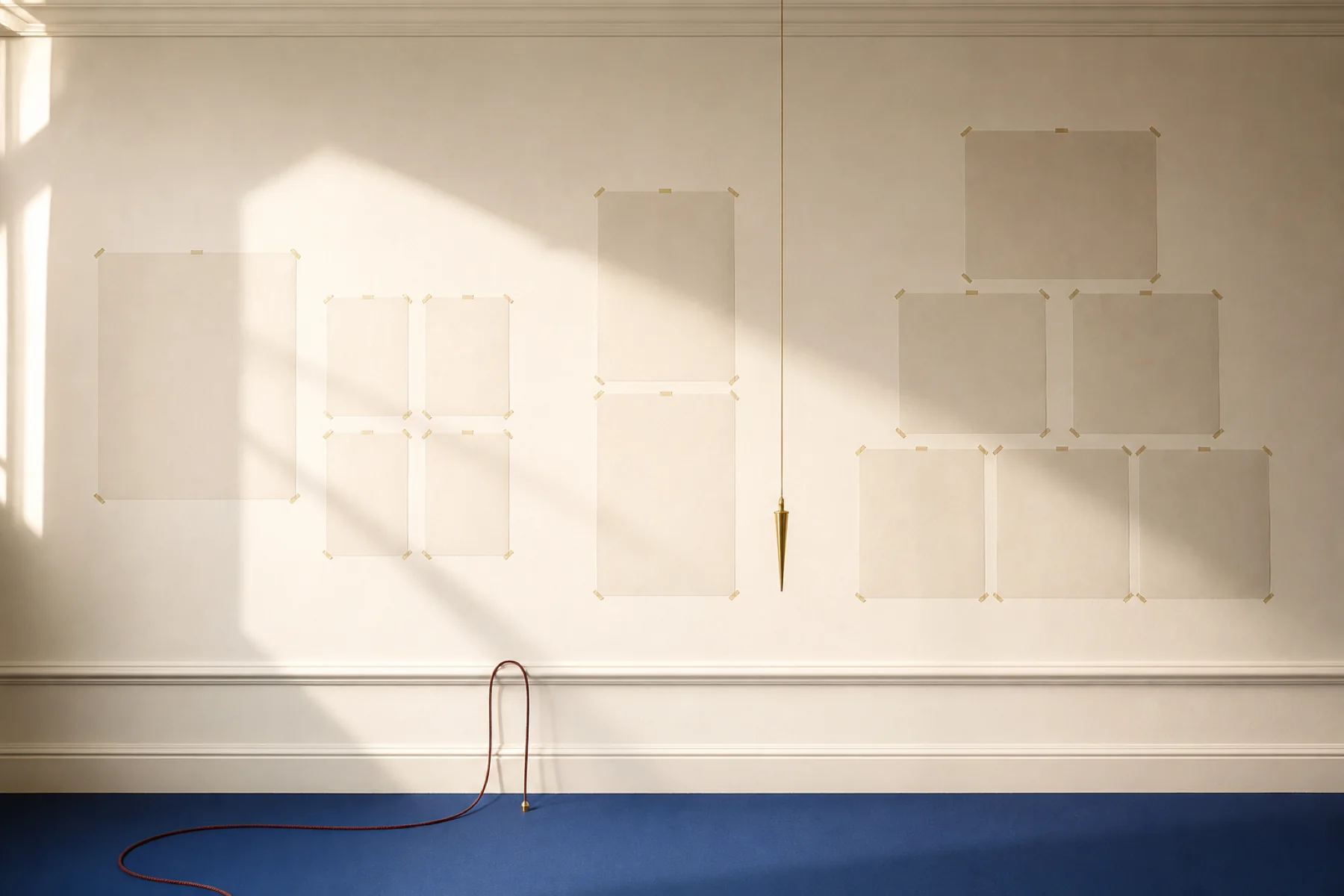
Choosing wall art size online can feel strangely abstract. A work that fills a laptop screen may be intimate in person; a painting described as large may become perfectly calm on a long wall. Dimensions only become meaningful when they are compared with furniture, sightlines and the distance from which the work will be seen.
The aim is not to find a universal formula. It is to replace guesswork with a measured outline, then let the artwork decide whether the room needs presence, breathing space or a deliberate point of tension.
Measure the usable wall, not the whole wall
Begin by identifying the actual display zone. Measure its width and height, then note doors, switches, vents, lamps, moulding and furniture that reduce the usable area. A wall may be twelve feet wide while the meaningful space above a console is only six.
Record the furniture width and height, ceiling height and normal viewing distance. For a framed work, use the outer frame dimensions rather than the canvas or image size. A mat and frame can add substantial width to a print; a floating frame adds less, but it still changes the silhouette on the wall.
Also measure the route into the room. A work that suits the wall must still pass through doors, stair turns and lifts. This is particularly important for a large stretched canvas, framed work under glazing or sculpture.
Use proportion as a starting point, not a command
Above a sofa, bed, sideboard or console, a single artwork or grouped arrangement often feels connected to the furniture when it spans roughly two-thirds of its width. Treat this as a visual starting point rather than a rule. A spare interior may welcome a narrower work surrounded by silence; a bold horizontal painting may comfortably occupy more.
For example, above a 90-inch sofa, an arrangement around 60 inches wide gives you a useful first outline to test. That width might belong to one large canvas, a diptych including the gap, or several smaller works read as one composition. Keep the group narrower than the furniture unless a deliberate asymmetry is part of the design.
Width solves only half the problem. Leave enough space above the furniture for the two elements to breathe without drifting apart. The guide to how high to hang art covers eye level and spacing after the size is chosen.
The right scale does not merely fill an empty wall. It gives the room a centre of gravity.
Account for visual weight
Two works with identical dimensions can occupy a room differently. Deep colour, strong contrast, a heavy frame and dense texture give an artwork more visual weight. Pale colour, open composition and a frameless edge can feel lighter. A small saturated painting may hold its own on a broad wall, while a quiet image may need greater physical scale to create the same presence.
Shape matters too. A tall portrait format carries the eye upward and can make use of narrow walls. A horizontal work follows the line of a sofa or dining table. A square creates a stable focal point. Before rejecting an artwork as too small, consider whether a wider frame, generous mat or companion piece would give it the needed structure.
Choose one large work, a pair or a gallery wall
One large artwork
A single work creates clarity. It is especially effective when the image has enough presence to hold a long wall or when the room already contains many objects. Measure the finished outside dimensions and test the complete rectangle, including the frame.
A diptych or pair
Two works create rhythm and can suit a wide space without requiring one difficult-to-transport object. Calculate their combined width plus the planned gap. Keep the gap close enough that the eye reads a relationship rather than two unrelated islands.
A gallery wall
Treat a gallery wall as one large shape. Arrange paper templates on the floor first, then measure the outer boundary of the whole group. Consistent spacing can unite different frames and formats; alignment through a shared centre line, top edge or visual axis keeps variety from becoming accidental.
Adjust scale room by room
Living room: judge the work from the main entrance and primary seating position. A large room usually needs either a substantial focal piece or a group with enough total width to remain legible across the space.
Bedroom: art above a bed should relate to the headboard, not the full wall. A horizontal work, pair or quiet group often follows that width gracefully. Check that the frame and hanging method are appropriate for a position above furniture.
Dining area: consider how the artwork looks both standing and seated. A long table can support a horizontal composition or sequence, while a tall work on the end wall can draw the eye through the room.
Hallway or stair: viewing distance is shorter and movement matters. Smaller works can invite close looking, but deep frames or projecting sculpture should not narrow a busy route. On stairs, plan the group as a stepped whole before drilling.
Open-plan space: use art to give one zone an identity. Measure against the furniture grouping beneath it rather than the entire architectural wall.
Test the outline before buying
Use low-tack painter's tape to mark the proposed outside dimensions on the wall. Step back to every normal viewpoint, sit down and photograph the outline. Leave it in place through daylight and evening light. This simple test reveals whether the work will be crowded by a lamp, lost above furniture or visually cut by a doorway.
For more realism, tape together sheets of paper or cardboard in the exact shape. Mark the image area inside the frame. If planning several pieces, cut one template for each and label it. Digital room mock-ups are useful for comparison, but perspective can distort scale; confirm every decision with real measurements.
Read artwork dimensions correctly
A listing should make clear whether dimensions refer to the image, sheet, canvas, frame or entire object. Height is commonly stated before width, but do not assume — ask. For a diptych or triptych, confirm whether the listed width includes the recommended spaces between panels.
Check orientation, depth and weight as well as height and width. Depth affects shadows and side views; weight determines suitable hardware and may require professional installation. If framing is not included, read the guide to framing a canvas painting before finalising the wall plan.
A wall art size checklist
- Measure the usable display zone and every nearby obstacle.
- Record furniture width, ceiling height and normal viewing distance.
- Confirm whether the listed dimensions include the frame or spaces between panels.
- Compare one work, a pair and a grouped arrangement at the same total scale.
- Mark the exact outside dimensions on the wall before buying.
- Check access, weight, hanging hardware, light and safe clearance.
The practical measurements protect the decision; they do not make it for you. Explore available MARIEZAL originals with dimensions and signed fine art prints. If a work keeps returning to your attention, contact the studio for exact object, frame and delivery details, then test its true outline in your room.