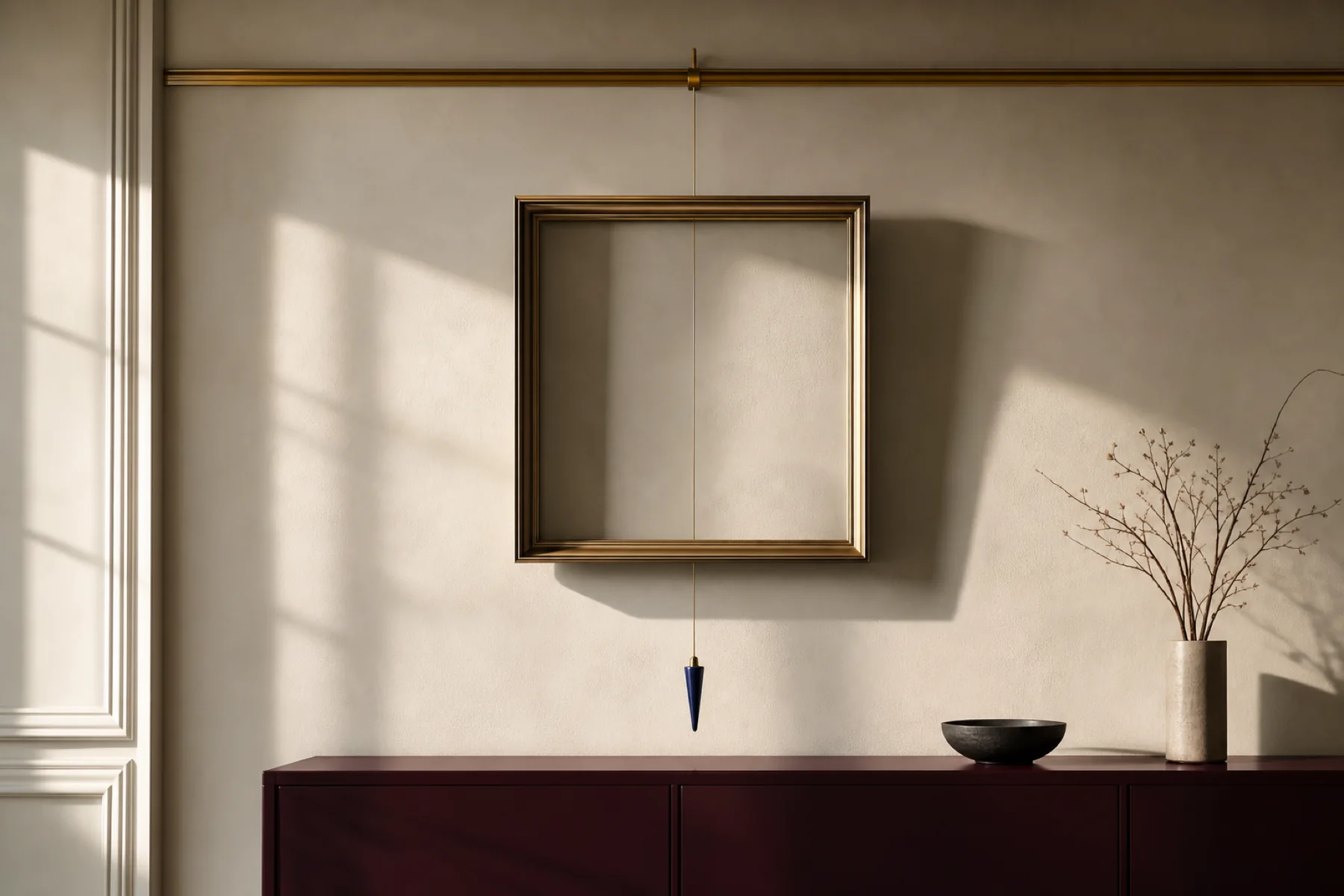
Art is often hung too high because we instinctively respond to the empty wall rather than to the people in the room. A work should meet the viewer, not hover above them. The familiar eye-level rule is a useful beginning, but furniture, ceiling height, artwork proportions and the way a space is used all affect the final position.
The short answer: centre art near eye level
For a single artwork on an open wall, begin with the centre of the work about 57 to 60 inches (145 to 152 centimetres) from the floor. This range is a starting point, not a law. It creates a comfortable average viewing height and gives multiple works a consistent visual line.
Measure the artwork itself, not just the wall. The hanging point will sit above its centre, and wire can rise when loaded. If a 30-inch-high frame should have its centre at 58 inches, its top will sit at 73 inches. Measure the distance from the frame's top to the tightened wire or hardware, then subtract that distance from 73 inches to locate the hook.
How high to hang art above a sofa
Above a sofa, console, headboard or mantel, the artwork should read as part of the furniture grouping. Start with the bottom of the frame roughly 6 to 10 inches (15 to 25 centimetres) above the furniture. A very tall ceiling is not a reason to widen this gap dramatically; the relationship below matters more than the empty space above.
Width matters too. A single work or grouped arrangement often feels balanced when it spans about two-thirds of the furniture width. This is a visual guideline, not a purchasing formula. A deliberately small work can feel intimate when it has enough breathing room, and an oversized painting can create a powerful architectural effect.
Hang for the human body first, the furniture second and the ceiling last.
Room-by-room adjustments
Living room
Decide whether the work belongs to the sofa, a console or the wall as a whole. If it belongs to furniture, use the lower-edge spacing above. If it stands alone, use the centreline. Check the view from the doorway and from the seat you use most; a position that works while standing may feel oddly high from the sofa.
Dining room
People experience dining-room art while seated, so slightly lower placement can feel natural. Test the artwork at table height with a paper template. Make sure chair backs and moving diners will not touch the frame.
Bedroom
Above a bed, treat the headboard as the visual base and keep the grouping connected to it. Confirm that the fasteners match both wall type and artwork weight. In earthquake-prone areas or above any sleeping position, use hardware designed to resist lifting and movement; when in doubt, have a professional installer assess it.
Hallway and stairs
In a hallway, a consistent centreline calms a sequence of varied works. On stairs, follow the rise of the steps with an imaginary line through the centre of the grouping rather than measuring every piece from the downstairs floor. Walk the route before fixing anything permanently.
How to hang a gallery wall
Treat the complete arrangement as one large artwork. Establish its overall centre near eye level, then build outward from a strong anchor piece. Keep gaps reasonably consistent — often 2 to 4 inches (5 to 10 centimetres), depending on frame size — so the group feels intentional.
Trace every frame onto kraft paper, mark its hanging point and tape the templates to the wall. This reveals whether the composition leans, crowds the furniture or grows too far upward. Photograph the paper arrangement from across the room; the reduced view makes imbalance easier to notice.
A five-step measuring method
1. Record the finished dimensions
Measure the artwork after framing. A mat and frame can change both scale and hanging height substantially.
2. Choose the relationship
Decide whether the work relates to eye level, nearby furniture or a larger group. Do not try to satisfy all three rules when they conflict.
3. Make a full-size paper template
Painter's tape can suggest an outline, but paper is better for testing height and composition without staring at a rectangle of tape through the work.
4. Mark the actual hardware point
Measure the distance from the frame top to the taut wire, D-rings or cleat. Two hooks can improve stability, but they must be level and positioned to match the installed hardware.
5. Check, then install
Live with the template for a day. View it while standing, seated and entering the room. Only then choose fasteners rated for the artwork's weight and compatible with drywall, plaster, masonry or a wall stud.
Light and safety matter as much as height
A perfect position can still be damaging if it receives direct sun, heat from a fireplace or repeated humidity from a bathroom. Choose stable conditions and use directional light that does not heat the surface. Heavy, glazed or unusually shaped work deserves professional installation. Keep the artist's care instructions and condition photographs with the purchase documents.
Let the artwork correct the formula
A portrait may ask to meet your gaze. A horizontal work may need to settle close to a sofa. A tall, quiet piece may feel strongest with generous space around it. Begin with the measurements, then move the template until the work feels connected rather than merely centred.
If you are still deciding on scale, read how to choose original art for your home. Explore the dimensions of current original works and fine art prints, or contact the studio for exact specifications before planning a wall.