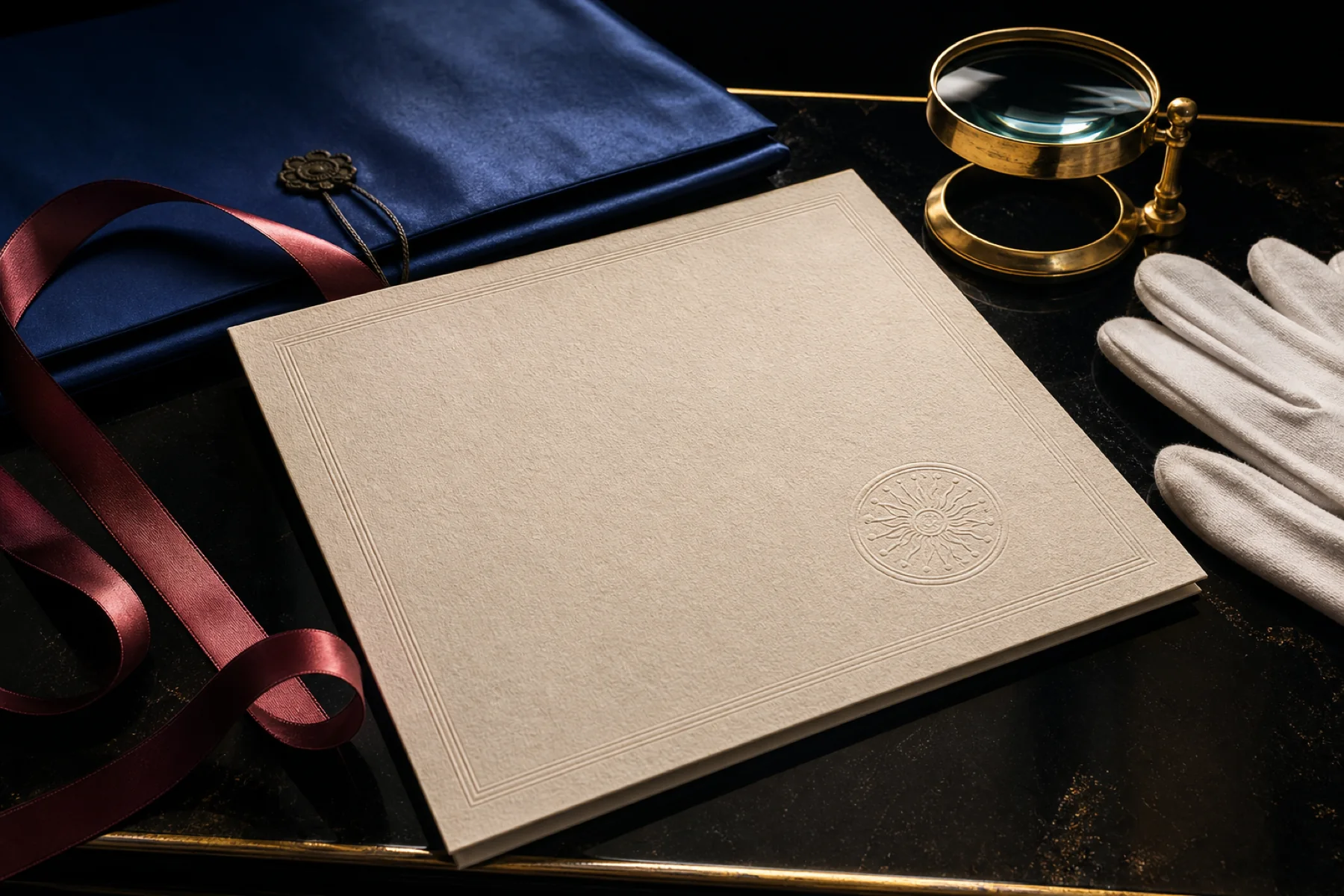
An art certificate of authenticity, often shortened to COA, is a document identifying an artwork and affirming who made or authorised it. For a living artist's work purchased directly from the studio, the strongest certificate comes from the artist or an authorised representative and matches the physical object in specific, verifiable detail.
The paper itself is not magic. A beautiful seal, embossed stamp or expensive folder cannot replace accurate information and a credible source. Treat the certificate as one part of the artwork's documentation, alongside the invoice, correspondence, photographs and ownership history.
What a useful certificate should identify
There is no single universal design, but a useful certificate should allow a future reader to distinguish this artwork from every other one. Look for clear, internally consistent information rather than decorative language.
- Artist's full name.
- Artwork title and year of completion.
- Medium and support, such as acrylic and mixed media on stretched canvas.
- Dimensions, with units and an indication of whether they include the frame.
- A statement that the object is an original, or precise edition information for a print.
- An identifying image or reference number when the artist uses one.
- Name and role of the person or organisation issuing the certificate.
- Signature and issue date.
The title, spelling, dimensions and medium should match the invoice, the seller's listing and any label on the work. Small differences may have an innocent explanation, but they should be resolved in writing while the purchase is recent.
Originals and editions require different details
For a unique original artwork, the document should state clearly that the work is one of one. For a limited edition, it should identify the print process or medium, paper or support, image and sheet dimensions when relevant, edition size and the individual number — for example, 7/50.
Ask whether artist's proofs or other editions exist outside the numbered run and whether the same image is offered in additional sizes. The guide to original art versus prints explains why terms such as limited edition, open edition and reproduction should not be treated as interchangeable.
Documentation matters because memory is intimate but imprecise. Years later, the record should still know exactly which object entered your life.
What a certificate cannot prove by itself
A certificate is only as reliable as its issuer and its connection to the artwork. Anyone can print a document, so an unsigned template from an unknown seller carries little authority. A COA also does not guarantee future value, investment performance, perfect condition or legal title in every circumstance.
Buying the physical work generally does not mean buying the copyright. Reproduction, publication and commercial-use rights should be addressed separately in writing if they matter to the transaction. The certificate identifies the artwork; it is not a substitute for a licence or a complete sales agreement.
Provenance is related, but not identical
Provenance is the documented history of an artwork's ownership, custody and movement. For a new work acquired directly from the artist, the chain may be simple: artist, studio invoice, collector. As a work changes hands, bills of sale, exhibition records, gallery labels, shipping documents and dated photographs can help preserve that history.
A certificate speaks to identity and authorship; provenance explains where the object has been. One document may support the other, but neither should be stretched beyond what it actually records. Keep original documents rather than rewriting their details into a new summary and discarding the source.
Check the object against the document
Before final payment or as soon as the work arrives, compare it with the certificate in good light. Confirm the front, back, edges, signature or identifying marks, dimensions, medium and frame. For a textured work, request angled photographs that show the actual surface instead of relying only on a polished room mock-up.
If the artwork was shipped, document the package before opening when damage is visible and photograph the work immediately after unpacking. Condition is separate from authenticity, but a dated arrival record helps establish what you received. Follow the guide to caring for original art for a simple condition record.
Questions to ask before buying
- Who issues and signs the certificate?
- Will it arrive with the artwork or separately?
- Do the listed medium, dimensions and date match the object offered?
- For a print, what is the edition size and individual number?
- Is the work signed, and where?
- What invoice, receipt and care information will accompany the purchase?
- How will a lost certificate be handled, and what proof would the issuer require?
Answers should be specific to the work. Phrases such as “museum quality,” “investment grade” or “fully certified” are not replacements for named materials, measurements, edition details and issuer identity.
Store the certificate safely
Do not attach the original document directly to the canvas or place it where acidic paper, adhesive or metal fasteners can affect the work. Store it flat in a clean archival folder, together with the invoice and care notes, in a stable and secure place. Keep a high-resolution digital scan and photographs of the artwork's front, back and identifying details in a separate backup.
If you sell or gift the work later, transfer the original documentation and retain a record of the transfer. Do not alter a certificate to update ownership; use a separate dated bill of sale or transfer document. If a certificate is lost, contact the original issuer. Never create a replacement yourself or add a copied signature.
Documentation from a living artist's studio
Buying directly from a living artist offers unusual clarity: questions can be answered by the source while the materials, process and date are still close at hand. MARIEZAL states that each available original is signed and accompanied by a certificate of authenticity, and that its fine art editions are signed, numbered and certified.
For the precise documentation, medium, dimensions or edition status of a particular work, contact the MARIEZAL studio before purchase. A serious record should feel almost plain in its accuracy. The mystery belongs in the artwork, not in what the collector has bought.